
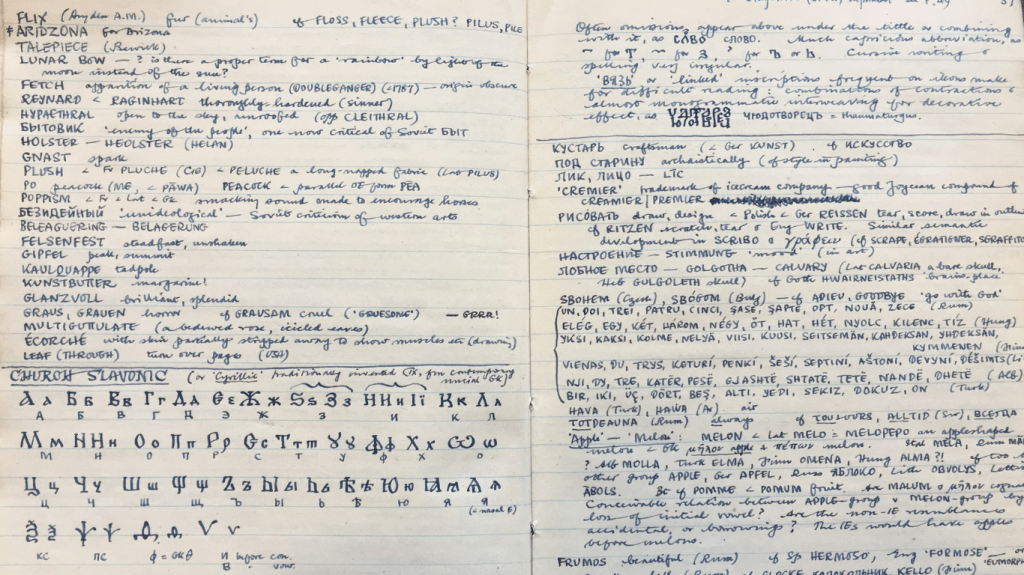
Translation was central to Edwin Morgan’s activity as a poet. His Collected Translations (Carcanet, 1996) is as voluminous as his own Collected Poems(Carcanet, 1990) and his lifelong commitment to making the voices of foreign cultures ring out in English and Scots was never a secondary preoccupation. During the years he wrote many of his most popular and enduring collections he was just as busy translating from a vast array of world languages.
In alternate years to the Poetry Award, the Edwin Morgan Trust sponsors biennial translation events that will bring some of the world’s leading foreign language poets to Scotland to participate in workshops and readings alongside Scottish poets.
In May 2017 the Trust funded a workshop with Portuguese and Scottish poets. Three acclaimed Portuguese poets — Andreia C. Faria, Ricardo Marques, Miguel Martins — worked closely with Edwin Morgan Prize-winning poet Jane McKie, the runner-up to the 2016 Edwin Morgan Poetry Award, Miriam Nash, and Whitbread Poetry Prize-shortlisted Richard Price to create new renderings of their poems for a Scottish context. In the days of translation activity at the Scottish Poetry Library, facilitated by poet Tom Pow, the Portuguese poets also translated the work of their Scottish colleagues.
About the participants
Andreia C. Faria lives in her native city of Porto. She has published four poetry collections, including Flúor (2013), Um pouco acima do lugar onde melhor se escuta o coração (2015) and Tão bela como qualquer rapaz (2017). ‘Poetry is a way of finding my place in the world and in my own body. It is a way of exploring my limits and my preconceptions. It is imagination to the extreme.’
Jane McKie teaches for the creative writing programme of the University of Edinburgh. Her most recent collections are From the Wonder Book of Would You Believe It? (Mariscat, 2016) and Kitsune (Cinnamon Press, 2015). ‘I hope my writing is imbued with imagination, compassion and, above all, a sense of wonder. I’m often drawn to the natural world in my writing, and to character, playfulness and quirkiness when I read.’
Ricardo Marques is a literary critic, translator and poet, currently living in Lisbon. Recent collections include Metamorphoses (2015) and Ruinenlust (2016). ‘Poetry is crucially a crucible: an experience of the world and a mir- ror. My poetry is a reflection on the past, present and future, three wor(l)ds we were given and we need to digest.’
Miguel Martins lives in Lisbon, and has published a number of poetry collections, also essays, a novel and songs. His poetry titles include: Cirrose (2003), Lérias (2011), Cotão (2014), Desvão (2016), Pince-Nez (2017). ‘If my poems have one main thing in common, I’d say it is their obsession with the past, be it historical, biographical or fictional.’
Miriam Nash, poet, performer and educator, was runner-up for the Edwin Morgan Poetry Award in 2016, and her first full collection, All the Prayers in the House (Bloodaxe), came out in 2017. ‘For me poetry is an oral form, so sound is important. I edit my poems aloud. I try to find the emotional heart of a poem—to share a moment of understanding with the listener/reader.’
Tom Pow is an award-winning poet and author. A bilingual selection of his poems was published in Mexico in 2015 and his latest collection is At the Well of Love (Mariscat, 2016). He was a Robert Louis Stevenson Fellow in 2015.
Richard Price is Head of Contemporary British Collections at the British Library, and author of a dozen poetry collections, most recently Small World (Carcanet, 2012) and Moon for Sale (Carcanet, 2017). ‘I favour a technically various poetry about a great range of subjects, and even abstraction, barely expressing a subject at all. From intimate witness to world infinite!’
Last Fish
She was a perfect mackerel of
Cape Cod, almost shivering as if
the sea had surged her to my plate.
I ate her slowly, peeling back
the skin, holding her pale meat
between my teeth. I had come fresh
from my first dip this side of the
Atlantic, a family of water I had
known from birth. In the shallows,
dreaming, I had sensed my body
stretching with the tide, my limbs
teased out like nets across the calm,
the churn, the break, dark waters,
deep tectonic plates, until my toes
had touched my nook of icy
Scottish coast, my head still floating
in the lick of warmth. Let me be
eaten by an ocean, said the mackerel
on my tongue. She was beautiful
that fish. I never ate another one.
– Miriam Nash
O Último Peixe
Era uma cavala perfeita, de
Cape Cod, quase a tremer como se
o mar a tivesse arrastado para o meu
prato. Comi-a devagar, retirando-lhe
a pele, segurando-lhe a carne pálida
entre os dentes. Acabara de chegar
do meu primeiro mergulho deste lado do
Atlântico, uma massa aquática que
conhecia desde sempre. Nos baixios,
sonhadora, apercebera-me do meu corpo
alongando-se ao sabor da maré, dos meus membros
estendendo-se como redes sobre as águas
escuras, calmas, agitadas ou estagnadas,
sobre as profundas placas tectónicas, até que
os meus pés tocassem o meu recanto gelado
de costa escocesa enquanto a minha cabeça flutuava
ainda numa réstia de calor. Deixa-me ser
comida pelo oceano, disse a cavala
na minha língua. Era um belo peixe,
aquele. Nunca mais comi nenhum.
– Translated by Miguel Martins with Caterina Nascimento
Please read the Portuguese workshop pamphlet with poems and translations: The other side of silence
 edwinmorgantrust.com