
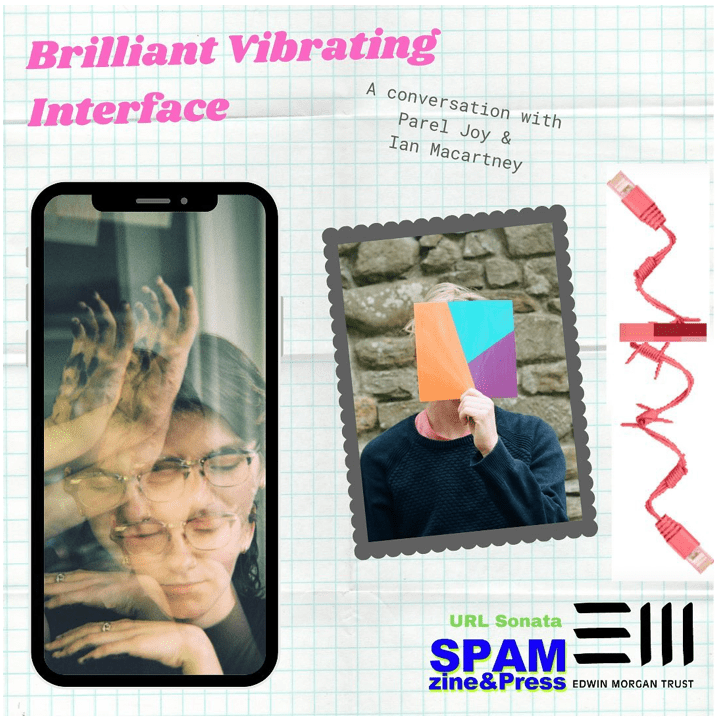
SPAM Zine and Press used their TSLA grant to fund workshops, podcasts and editorial features in the lead up to a book-length publication and digital exhibition inspired by Edwin Morgan’s assertion that ‘Poetry is a brilliant vibrating interface between the human and the non-human’.
Taking their cue from Edwin Morgan’s assertion that ‘Poetry is a brilliant vibrating interface between the human and the non-human’, this project traced the liquid pixels, folds and veils of various kinds of interface: from language to the ever-present digital screens of our lives. Uniting several concerns of Morgan’s own writing – queerness, experiment, hybridity and technology – Brilliant Vibrating Interface offered a dynamic and multiplatform series of creative outputs and community events based online and in Glasgow. SPAM investigated, published and sparked conversation around queer literary experiments in the digital age; in turn, expanding the canon to highlight the work of younger, emergent writers. With emphasis on works which engage explicitly, in form and content, with the internet, they hosted a series of podcasts, interviews and workshops, leading up to a book-length anthology publication and digital exhibition.
Brilliant Vibrating Interface highlighted the continual influence and relevance of Morgan’s work as a proto-internet poet (who wrote code, computational and concrete poems informed by machines) by placing his legacy in direct conversation with digitally native (‘post-internet’) writers and artists – from Morgan’s instamatics to the Instagram poetry of today. At the heart of this project was SPAM and Morgan’s shared passion for poetry in dialogue with the visual, with technology, everyday life, sexuality and gender. Their research and interview phases explored the media, process and tools behind post-internet poetry as well as its cultural contexts, offering insights into how and why poets are engaging with various technologies in their work.
SPAM Press
Workshops
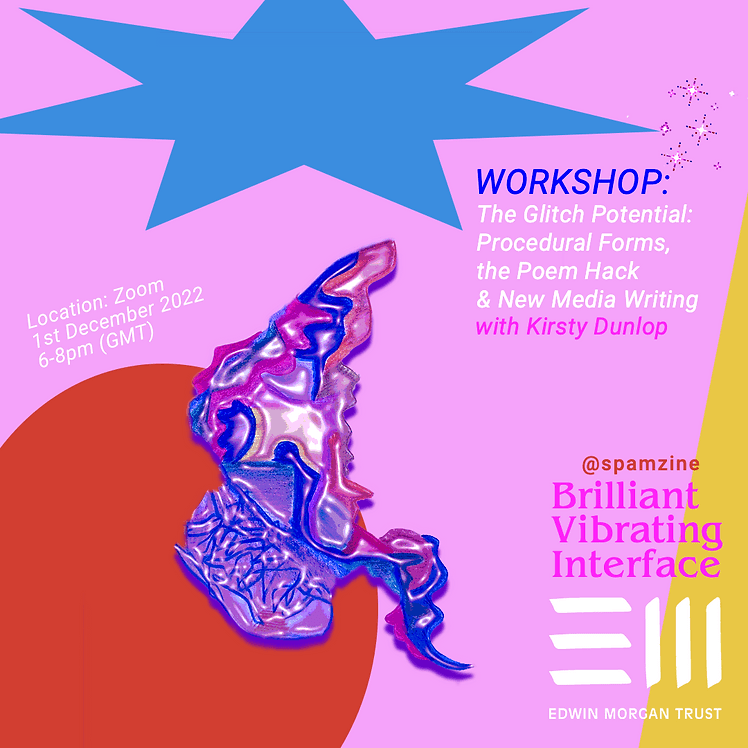
This workshop explored New Media Writing to provide participants with the tools and ideas to craft their own digital poetics and hybrid works (including hypertext forms, game writing, and social media poetics). If, as Legacy Russell claims ‘This glitch is a correction to the “machine”, and, in turn, a positive departure’, how might poetics and alternative ways be used to interact with Web 2.0, as a site of queer experimentation and possibility?
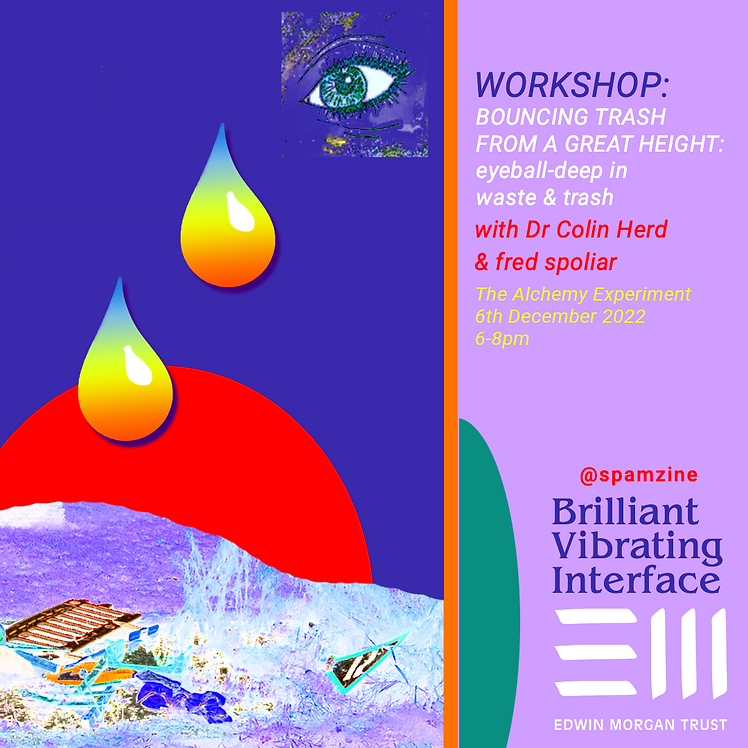
“Why bounce trash from a great height?” asked Edwin Morgan in ‘From the Video Box’, a long poem in sections taking the form of a poetic dumping ground for audience responses to televisual and media culture. This workshop looked at what it means to be attentive to channels of waste circulation and the processes by which trash gets designated as such. Playing with the idea of trash as an archive, participants explored preserving, iconising or fixing the evanescent.
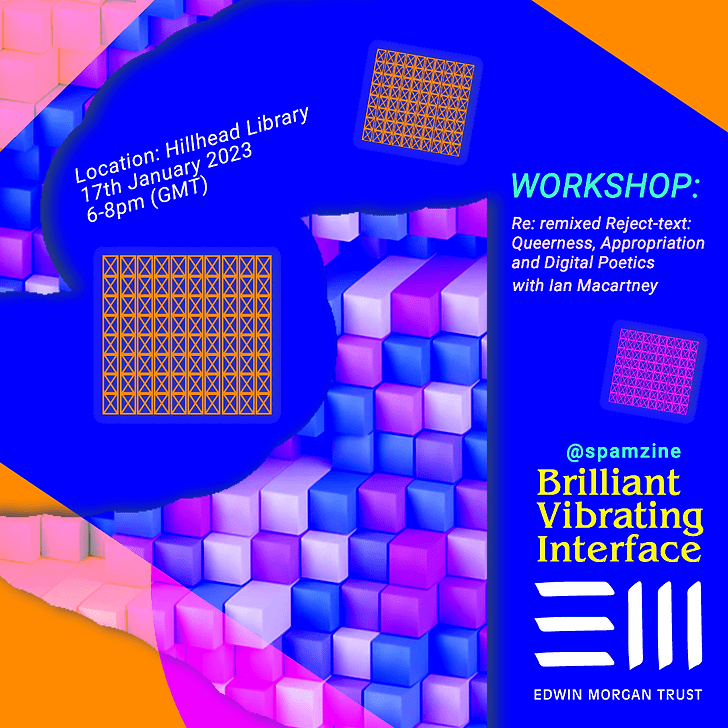
What does it mean to ‘remix’ existing text – to ‘bitcrush’ words sampled from another website? What happens when that jargon takes over? What does it mean to ‘replace’ a word from the internet with one of your ‘own’? And how does this all tie to queerness? Signposted with examples by Edwin Morgan, Rosie Stockton and Elijah Emerald, this workshop explored both the playfulness and radicality in remaking text – to go beyond/’queer’ the found poem – while also considering the limits of that approach.
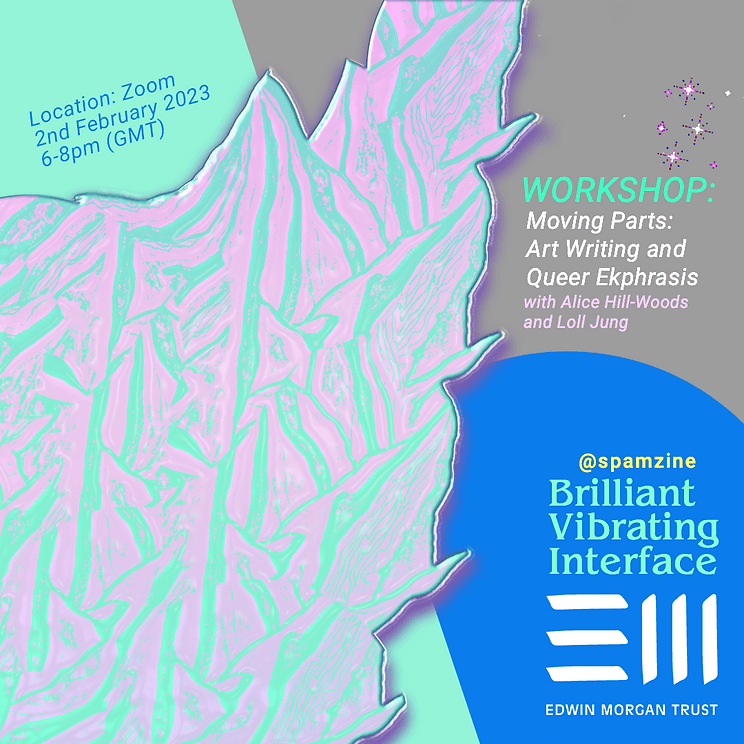
What are the ‘brilliant vibrating’ poetics of responding to something? Meditating on art writing as an ‘interface’ between objects and text, this workshop introduced participants to exercises that anchor writing across slippery terrains. Beginning with the basics of ekphrasis – the practice of writing through, from, and against art, and vice versa – participants were guided through experiments that “queer” such a practice.
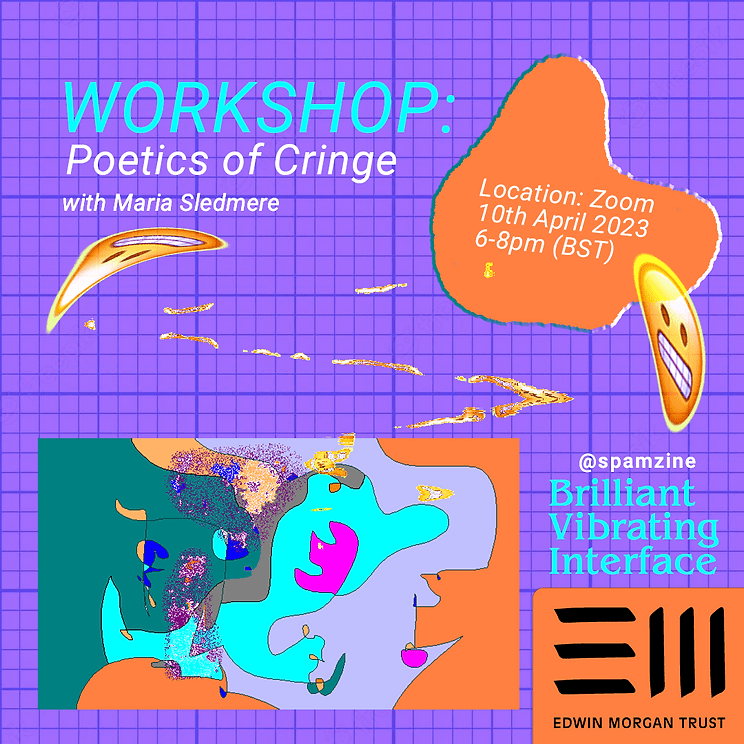
In a 2022 piece for Poetry Foundation, Chaelee Dalton writes: ‘Fanfiction is often called cringe because anyone can write anything about anything, meaning in reality, mostly young queer women and trans people can write mostly queer stuff about pop culture they love’. In this workshop, participants explored the queer art of cringe through desire, play, poemmaxxing and (dis)avowal. Working through forms and genres of cringe such as lyric, blogging, fan art and the pov or confessional, participants wrote and engaged with work which positions cringe as a post-internet experience of queer intimacy, ekphrasis and reclamation.
Podcasts
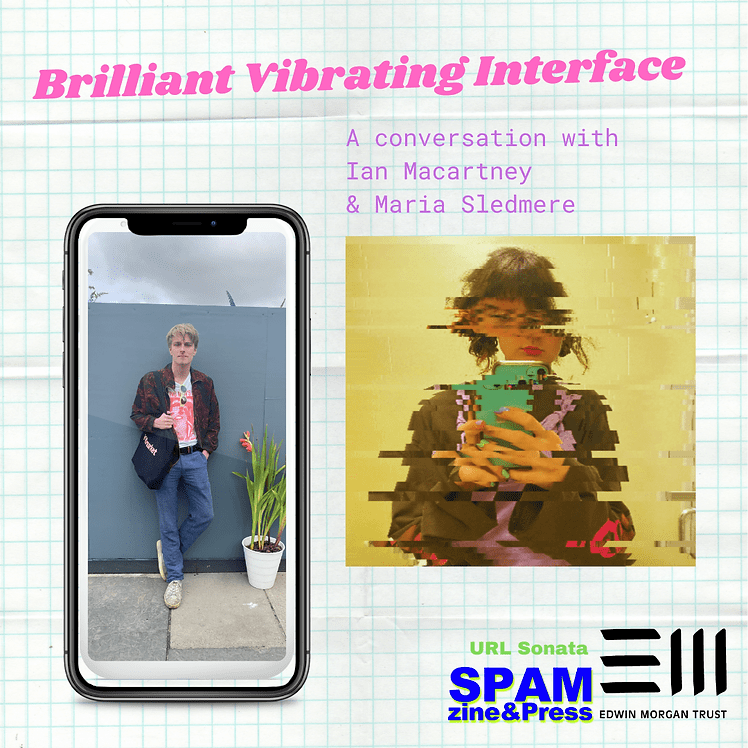
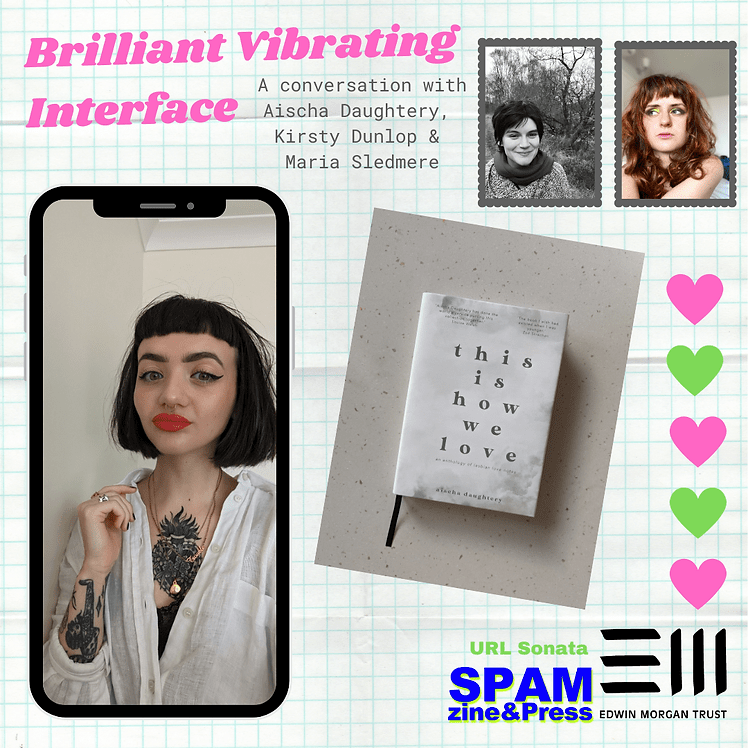
Anthology & exhibition

On 23 November SPAM launched Brilliant Vibrating Interface, a physical anthology and its digital sibling. Uniting several concerns of Morgan’s own writing – queerness, experiment, hybridity and technology – a truly multimedia collection of queer writing can be found in these pages and screens.
Project leaders
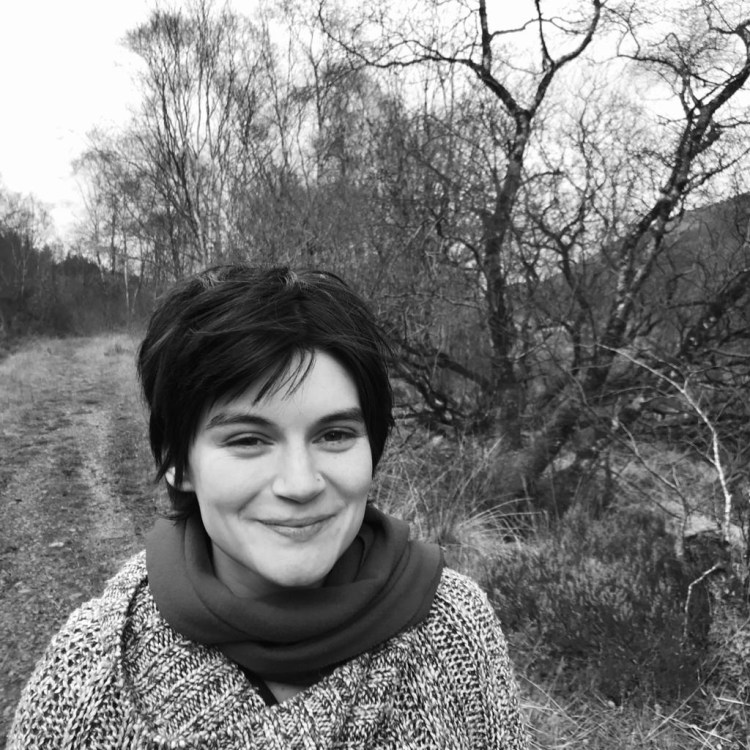

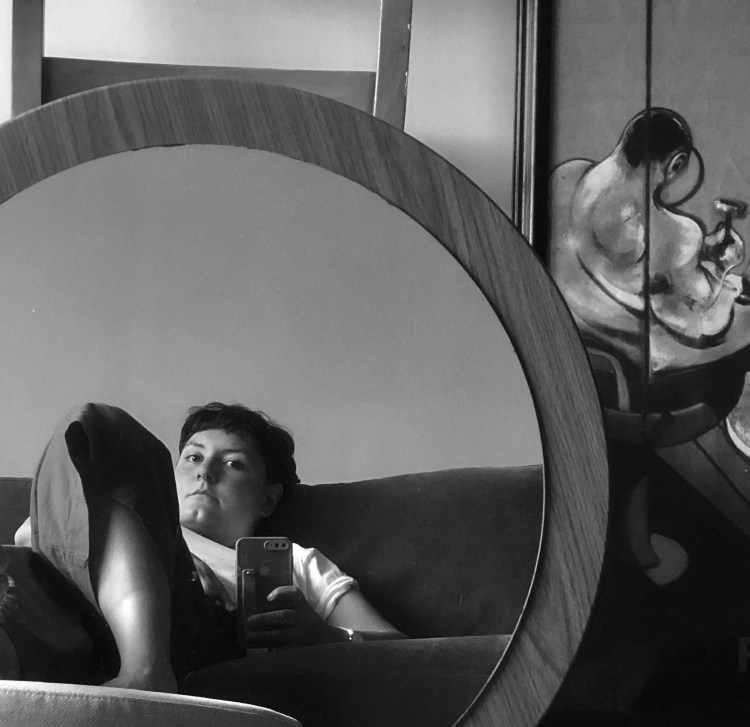

About the project leaders
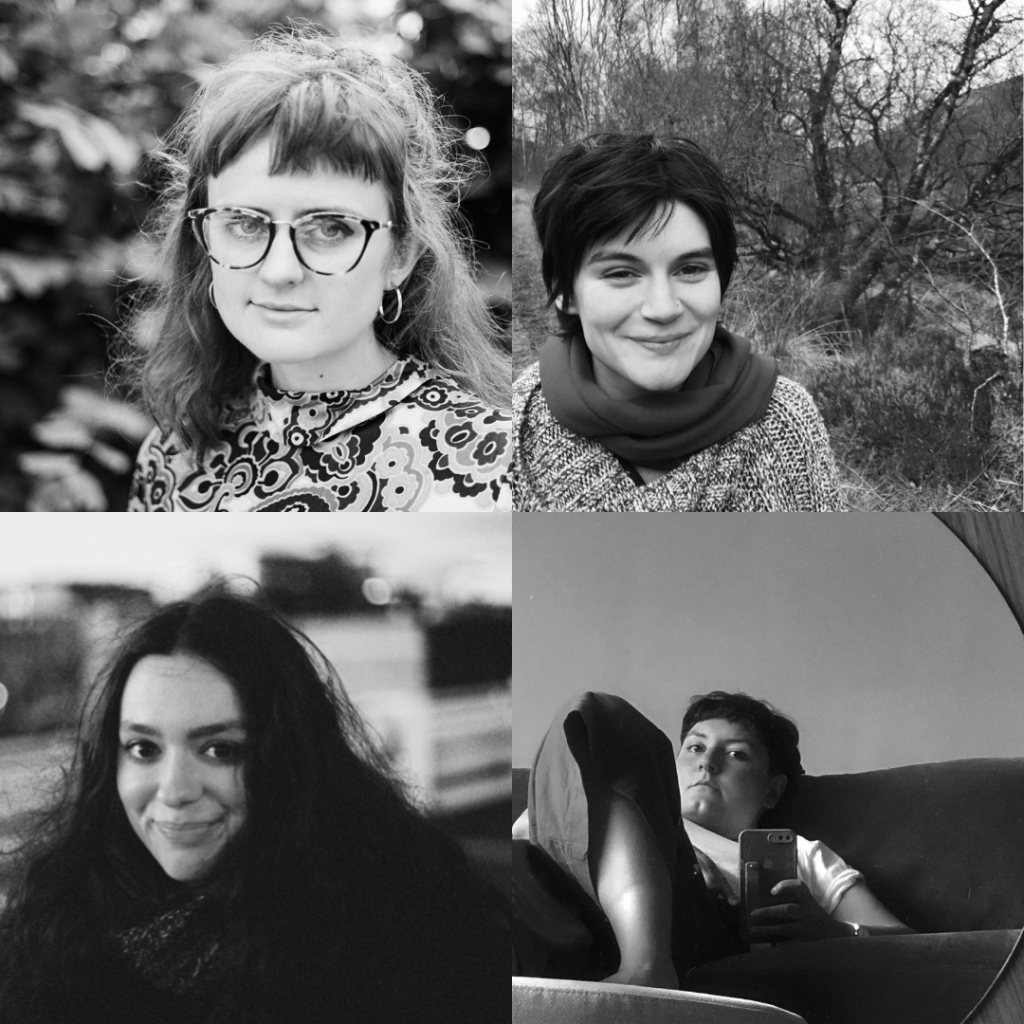
Kirsty Dunlop is a multimedia writer, editor, researcher and musician. She is working towards a DFA in Creative Writing at the University of Glasgow, exploring the possibilities of hybrid New Media writing and glitchful experiments through her concept of ‘Emergent Essaying’. She is a tutor in Creative Writing and English Literature at the University of Glasgow, regularly leads workshops and guest lectures on digital hybrid forms, and is a freelance Games Developer. She is Senior Editor at SPAM Press and recent publications include the collaborative pamphlet Soft Friction (Mermaid Motel, 2021) and multimedia research in ICIDS 2021 (Springer)
Alice Hill-Woods is an (art)writer, editor and researcher working across disciplines. She is working towards an MLitt in Art Writing at the Glasgow School of Art, and is the Poetry and Nonfiction Editor at SPAM Press. She is the author of HOTHOUSE (Saló Press, 2021), and recently published research on trauma ecologies in the Journal of Literature and Trauma Studies.
Loll Jung is a human animal residing in Glasgow, Scotland, with poetic and essayistic creative and critical work published with Dostoyevsky Wannabe, Nothing Personal, SPAM, Adjacent Pineapple, Gutter, and MAP. Their work examines processes of decline and regeneration through hybrid essaying and poetry, grappling with intersections of the queer body and its mythologies, ecologies, and memory.
Dr Maria Sledmere is a poet, critic and artist based in Glasgow, where she is Lecturer in Creative Writing at the University of Strathclyde. She tutors at Beyond Form Creative Writing, is editor-in-chief of SPAM Press, a member of A+E Collective and recent writer-in-residence at The Grammarsow in West Cornwall. An exhibition with Katie O’Grady and Jack O’Flynn, The Palace of Humming Trees, was shown at French Street Studios in 2021. With Rhian Williams, she co-edited an anthology, the weird folds: everyday poems from the anthropocene (Dostoyevsky Wannabe, 2020). Her second collection, Visions & Feed, is forthcoming with HVTN Press.
 edwinmorgantrust.com